
Update, September 20, 2026: The September 15 deadline discussed below did not take effect. A federal court paused the new F-1 rule on September 14, 2026, and F-1 students remain on duration of status for now. For the latest, read Change of Status to F-1 in Irvine: The September Deadline Is On Hold.
You are in the United States on a B-2 visitor visa, you have decided you want to study English, and you are preparing to file for a change of status to F-1. Until this summer, the main question was how long USCIS would take. Now there is a second question: which side of September 15, 2026 your approval lands on.
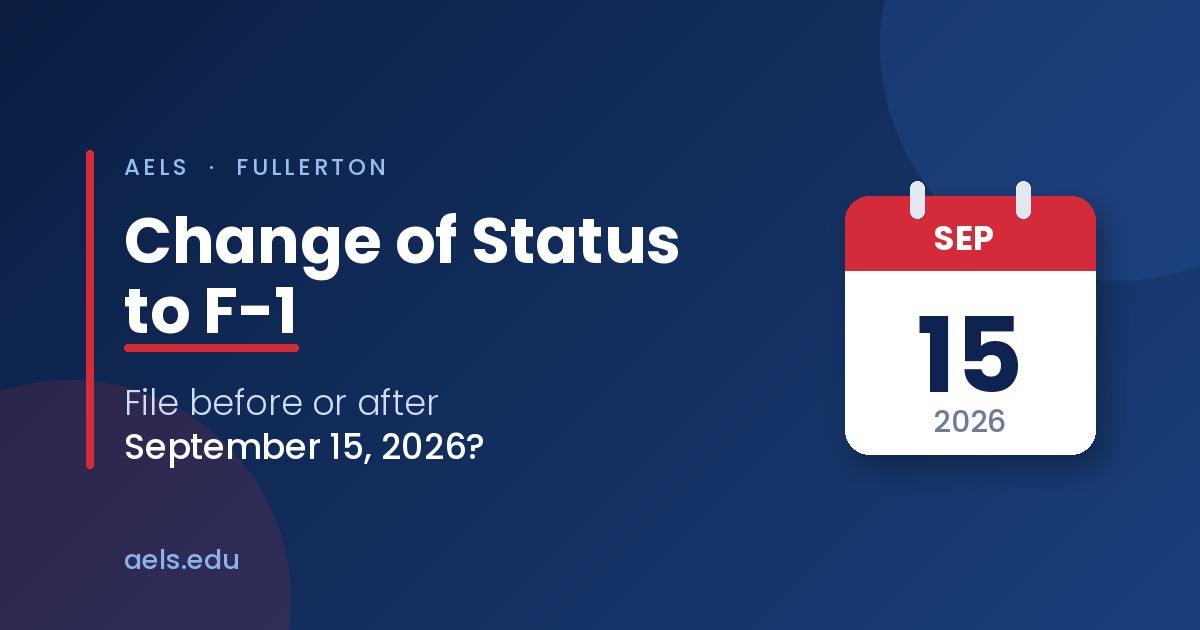
On September 15, 2026, a new DHS rule replaces "duration of status" with a fixed period of admission for F-1 students. We covered what that means for students already studying here in an earlier post. For someone changing status from B-2, the rule creates a practical fork in the road, because a change of status approval is itself an admission decision.
An approval issued before that date still grants duration of status. If you are in the United States in valid F-1 status and maintaining it on September 15, the transition provisions generally let you continue under duration of status until the program end date on your I-20.
Two details are worth knowing. Students in this group generally keep the 60-day grace period after finishing a program, rather than the 30 days the new rule allows. And time spent in English language training before September 15 does not count toward the new 24-month limit on ESL study.
One caution: traveling abroad and re-entering after September 15 ends that treatment. You would be readmitted under the new fixed-date system.
Your Form I-797 approval notice will include a new I-94 with a specific end date printed at the bottom. That date, not your I-20, controls how long you may stay. If you need more time, you file Form I-539 for an extension of stay with USCIS before that date arrives.
Overstaying also carries faster consequences now. Instead of waiting for a formal finding, unlawful presence can begin accruing as soon as your I-94 expires. More than 180 days can trigger a three-year bar to reentry, and a year or more can trigger a ten-year bar.
You may not begin classes until your change of status is approved. Studying while the application is pending is a status violation. Do not travel outside the United States while your I-539 is pending, or USCIS may treat it as abandoned. And you still need an Initial Attendance I-20 from a SEVP-approved school before you can file.
You cannot control when USCIS decides your case, so do not build your plan around hitting a particular date. What you can control is filing a complete, well-documented application as early as possible, with a sensible I-20 start date, and keeping your B-2 status valid the entire time you wait. That is where most change of status problems actually begin.
We are a SEVP-approved school, and we issue Initial Attendance I-20s for students changing status from B-2. Our team will help you pick a start date that works with your filing, keep your I-20 accurate, and plan your ESL timeline around the new 24-month limit, whether you are aiming at the TOEFL, a community college transfer, or a university pathway.
Come talk to us before you file. A short conversation now can save you months later.
This article is general information for AELS students and is not legal advice. Immigration rules and procedures may be updated, so please confirm the latest details with your AELS designated school official and official U.S. government resources (uscis.gov and studyinthestates.dhs.gov).
Learn more about our ESL programs at www.aels.edu or visit our AELS Fullerton location on Google Maps to experience small-group English classes focused on conversation, confidence, and real-life communication.
Published on August 20, 2026
American English Language School (AELS) is a CEA-accredited and SEVP-approved English language school authorized to issue I-20 forms for international students. Located in Los Angeles, Orange County (Fullerton), and Irvine, California, AELS offers small classes, conversation-focused lessons, and proven results through individualized learning experiences. If you’re serious about improving your English, join AELS today!