
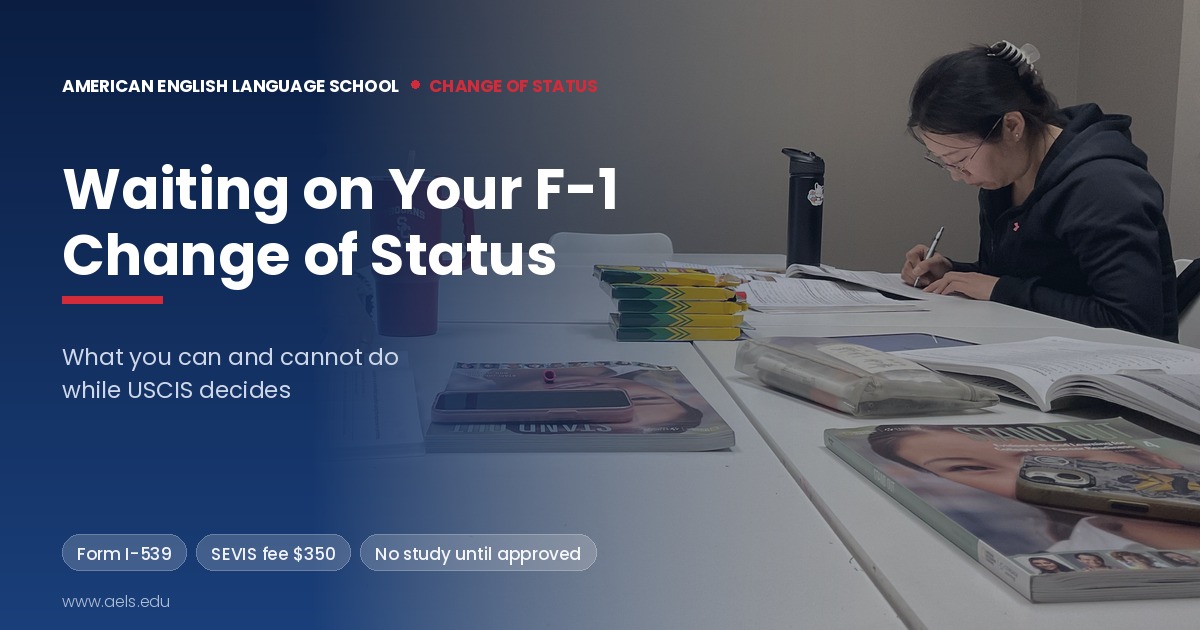
You filed Form I-539. The receipt notice arrived. And then, for months, nothing happens.
That waiting period is where change of status applications quietly go wrong. Not because the paperwork was bad, but because a student does something perfectly reasonable while waiting that turns out to be a status violation. Here is what the rules actually allow.
This is the one that catches the most people. If you are in the United States on a B-2 visitor visa, you may not enroll in or begin studying until your change of status is approved. Study in the States says it plainly: enrolling while you are in a non-student status is a violation. A school that lets you sit in on classes while you wait is doing you real harm.
The fix is simple. Choose a start date far enough out, and if approval is slow, move to the next term.
Good news for F-1 applicants: if your nonimmigrant status was valid on the day you filed, you are not required to hold status continuously all the way up to 30 days before your program start date. That break applies to F-1 applicants only. M-1 applicants whose status ends more than 30 days before their start date must file additional applications, with additional fees, to bridge the gap.
And if USCIS takes so long that your start date passes and the school defers you to the next term, you do not need to file anything extra, as long as your original status had not expired.
Departing the United States while Form I-539 is pending is generally treated as abandoning it. You would then have to apply for the F-1 visa at a consulate abroad and re-enter as a student instead. If a family visit or a wedding back home is coming up, talk it through before you book the ticket.
On-campus employment and practical training are F-1 privileges. They open only after approval, and only once you are within 30 days of your new program start date. A pending application is not permission.
Student change of status cases run in months, not weeks. Check the USCIS processing times tool before you assume something has gone wrong.
American English Language School is SEVP-certified, so we can issue the Form I-20 your application requires, and our Fullerton campus on Imperial Highway runs small-group classes built around conversation, reading, and writing. We will talk through start dates with you before you file, so your I-20 date and a realistic approval date are not in conflict.
Worth knowing: the new F-1 admission rule that had everyone racing toward September 15 is currently on hold. We covered that in Change of Status to F-1 in Irvine: The September Deadline Is On Hold. If you are already on F-1 at another school and thinking about moving, see our step-by-step F-1 transfer guide.
If you are in Fullerton and anywhere in the change of status process, whether you are deciding, filing, or waiting, come in and ask. No pressure and no decision on the spot.
This article is general information, not legal advice. Immigration rules change quickly. Confirm your situation with your designated school official and with the official sources at uscis.gov and studyinthestates.dhs.gov.
Learn more about our ESL programs at www.aels.edu or visit our AELS Fullerton location on Google Maps to experience small-group English classes focused on conversation, confidence, and real-life communication.
Published on September 23, 2026
American English Language School (AELS) is a CEA-accredited and SEVP-approved English language school authorized to issue I-20 forms for international students. Located in Los Angeles, Orange County (Fullerton), and Irvine, California, AELS offers small classes, conversation-focused lessons, and proven results through individualized learning experiences. If you’re serious about improving your English, join AELS today!